

Blog
A guide to IVF for lesbian couples
Articles | Fertility | IVF | NHS
All of our blog posts are written, edited, or produced by the Kind iVF Content Team. This is a collaboration between our expert writers, health editors, and the leading researchers and senior doctors at our clinics across the UK.
Families are created in many different ways, and deciding to start one is an exciting milestone. For same-sex female couples, that decision often comes with extra layers of planning and emotion; balancing joy and anticipation with the practical reality that medical help is needed to make it happen.
The good news is that there are now more family-building options for lesbian couples than ever before. In vitro fertilisation (IVF) is one of the most common and effective routes and same-sex couples now account for around 4% of all IVF cycles in the UK.
This guide explains how IVF works for lesbian couples, from treatment options and pathways to the IVF process itself, and how Kind iVF, in partnership with London Women’s Clinic and London Sperm Bank, offers inclusive, expert, and affordable care tailored to same-sex female couples.
Treatment options for lesbian couples
There’s no one-size-fits-all approach to fertility treatment. The right option depends on your fertility health, personal preferences, and how involved you’d each like to be in the process.
Here are the main treatment options available to lesbian couples.
IUI
Intrauterine insemination (IUI) is a less invasive and more affordable fertility treatment, often chosen as a starting point when there are no known fertility issues.
During IUI, prepared donor sperm is inserted directly into the uterus at the time of ovulation, giving the sperm the best chance of meeting and fertilising an egg. From there, the body takes over naturally.
The London Women’s Clinic has been supporting lesbian couples for over a decade and runs the largest donor insemination programme in the UK.
Success rates for IUI are typically lower than IVF, usually around one-third as effective, so it may take multiple cycles to achieve pregnancy but it does provide the option to transition to IVF afterward.
IVF with donor sperm
With IVF using donor sperm, eggs are collected from one partner and fertilised with donor sperm in a laboratory. Once fertilisation occurs, an embryo is transferred into the uterus.
IVF may be chosen if IUI hasn’t been successful, or it can be the first option if you’d prefer higher success rates or have additional fertility considerations. While IVF is more expensive than IUI, it also has better outcomes. The average success rate for IVF in lesbian couples is around 50% per cycle.
Since opening in 2022, Kind iVF has supported many same-sex partners in building their families using donor sperm from the London Sperm Bank, with expert, compassionate care at every stage.
Reciprocal IVF
Reciprocal IVF, also called shared motherhood, allows both partners to play a biological role in conception. One partner’s eggs are retrieved and fertilised with donor sperm, while the other carries the resulting embryo and gives birth.
This treatment has grown in popularity over recent years and is now one of the most common treatment options for lesbian couples at the London Women’s Clinic.
How does IVF work for lesbian couples?
The exact IVF process depends on your chosen treatment type and personal treatment plan, but the main steps are broadly similar.
IVF with donor sperm
Before starting, you’ll need to select your donor. You may choose a known donor (someone you know personally) if they meet screening criteria, or an anonymous donor through a licensed sperm bank.
At Kind iVF, we partner with London Sperm Bank to make donor selection simple and stress-free. You’ll receive guidance on choosing a donor, ensuring the sperm arrives at your clinic in time for treatment.
Once your donor is confirmed, the IVF process begins:
Step 1: Cycle regulation and ovarian stimulation
You may take medication to regulate your menstrual cycle, which is then followed by hormone injections to stimulate your ovaries and produce multiple eggs. Medication also prevents premature ovulation. Your progress is tracked with regular scans and blood tests, and when your eggs are ready, a final trigger injection prepares them for collection.
Step 2: Egg collection
This minor procedure is carried out under sedation. Using ultrasound guidance, a fine needle retrieves the eggs from your ovaries. You’ll rest for a few hours before going home and may feel bloated or mildly crampy for a day or two.
Step 3: Donor sperm preparation
Your donor sperm is thawed and prepared in the lab, where it’s checked for motility, concentration, and quality.
Step 4: Fertilisation
The eggs are placed in a culture dish with the donor sperm to allow fertilisation. Sometimes, ICSI (intracytoplasmic sperm injection) is used, where a single sperm is injected into each egg. The resulting embryos are monitored closely as they develop.
Step 5: Embryo transfer
Three to five days later, the best-quality embryo (or occasionally two) is transferred into the uterus. The procedure is quick, doesn’t require sedation, and uses ultrasound for accuracy. A full bladder helps with visibility. You can resume normal activities afterwards, although some people prefer a quiet day of rest.
Reciprocal IVF
Reciprocal IVF follows the same general steps but involves both partners.
One partner undergoes stimulation and egg collection (Steps 1and 2), and their eggs are fertilised with donor sperm (Steps 3 and 4). The other partner then has the embryo transfer (Step 5) and carries the pregnancy.
This shared experience can feel especially meaningful, allowing both partners to contribute, one genetically, one gestationally, to the creation of their child.
Can lesbian couples have IVF on the NHS?
Yes, lesbians can have IVF on the NHS, but there are eligibility criteria that must be met, which makes navigating NHS IVF as a lesbian couple far from straightforward.
Most Integrated Care Boards (ICBs) require couples to prove they’ve tried to conceive through self-funded insemination before being eligible for IVF. Depending on your region, that can mean 6 to 12 unsuccessful insemination attempts, which can be both emotionally and financially demanding.
Eligibility criteria for NHS-funded IVF
Although specific rules vary by ICB, the following are common requirements:
- Being non-smokers
- Having a BMI between 19 and 30
Other factors can also influence eligibility:
Age
The age criteria for funded IVF varies across ICBs with some offering IVF for those as young as 18 and others funding treatment for women up to the age of 42. For example:
- Lancashire and South Cumbria ICB: 1 full cycle for ages 18–42.
- Norfolk and Waveney ICB: 2 non-full cycles for ages 23–39 and 1 non-full cycle for ages 40–42.
- Buckinghamshire, Oxfordshire and Berkshire West ICB: 1 non-full cycle for ages up to 35.
- North East London ICB: 3 full cycles up to age 40, and 1 full cycle for 40–42.
Parental status
Some ICBs won’t fund IVF if either partner already has children; biological, adopted, or from previous relationships, even if those children don’t live with you.
Previous IVF cycles
Your IVF history can also affect eligibility. Some ICBs will only fund treatment if you’ve never had IVF before (NHS or private). Others allow limited self-funded attempts and count these towards your overall funded cycles allowance.
Private IVF for lesbians
If you aren’t eligible for IVF on the NHS, or you’ve already had funded rounds without success, that doesn’t mean it has to be the end of your journey. There are private treatment options available.
At Kind iVF, we specialise in helping lesbian couples become parents through Kind donor IVF, combining clinical expertise with inclusive, transparent care.
We focus on three key eligibility factors:
- Age: Under 37 when starting treatment medications
- BMI: Below 30
- Ovarian reserve: Good overall ovarian health
You’ll begin with a fertility health assessment and consultation to understand your reproductive health and confirm whether the streamlined Kind IVF pathway is right for you.
Our all-inclusive IVF with donor sperm package costs £4,500 per cycle and includes:
- Pre-treatment screening blood tests
- Stimulation medication
- Monitoring scans
- Egg collection and embryo transfer
- One vial of donor sperm from London Sperm Bank
- HFEA treatment fees
- Pregnancy blood test and early pregnancy scan
At selected locations, 0% finance is available to help spread the cost, making IVF for lesbian couples even more accessible.
For many lesbian couples, IVF represents not just a path to pregnancy but a shared journey of love, commitment, and hope.
At Kind iVF, in partnership with London Women’s Clinic, we’re proud to provide inclusive, expert fertility care that celebrates all families. From donor matching to embryo transfer, every stage of your treatment is guided by compassion and clinical excellence.
If you’re ready to take the next step and start your journey with Kind iVF, book a consultation.




Events
From our free clinic open days to our informative webinars, our events are here to inform and support you. Our open days are a great opportunity to meet the team, have a tour and receive a free mini doctor consultation. While our webinars allow you to log on wherever you are and get your questions answered.

This free event is a great opportunity to learn about our fertility services, visit our Colchester clinic and have a…

This free event is a great opportunity to learn about our fertility services, visit our Darlington clinic and have a…

Free talk on Kind iVF, an affordable, all inclusive, IVF pathway. Ask our experts, book a mini consult, and leave…
Whether you’re just starting to think about fertility treatment or actively planning your next step, our Kind iVF Open Day is the…
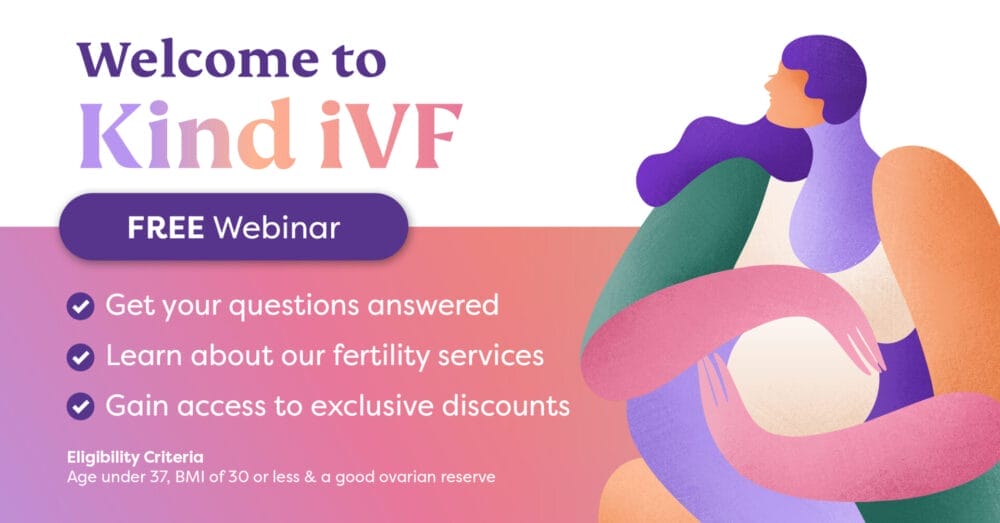
Whether you’re just beginning to explore fertility treatment or planning your next step, this free Kind iVF webinar is the…
Whether you’re just starting to think about fertility treatment or actively planning your next step, our Kind iVF Open Day is the…
Whether you’re just starting to think about fertility treatment or actively planning your next step, our Kind iVF Open Day is the…

Whether you’re just starting to think about fertility treatment or actively planning your next step, our Kind iVF Open Day is the…
Kind iVF Brentwood Open Day is the perfect place to begin. This welcoming event is open to: Kind iVF offers a…